
Models: Carriers of Engineering Judgement
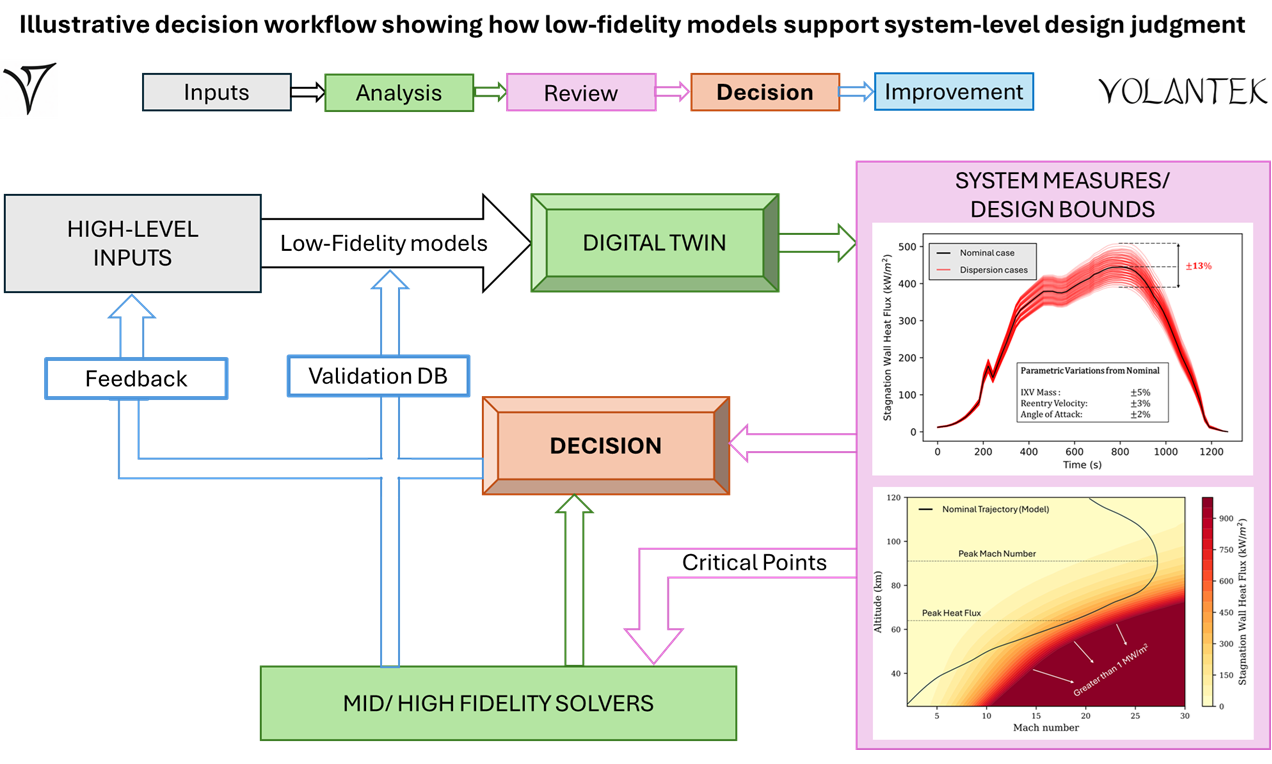
Low-fidelity, physics-based models are often viewed as preliminary tools — useful early, then replaced by higher-fidelity analysis. In practice, their most important role is different. When constructed carefully, low-order models act as carriers of engineering judgment, not just predictors of numbers. They make assumptions explicit, expose sensitivities, and clarify how design choices interact with trajectory, environment, and operational constraints. This is what allows teams to see trade-offs early, before uncertainty becomes expensive to correct.
In hypersonic and space systems, assumptions propagate across design, scale-up, and operation — here numerical precision alone is not enough. High-fidelity tools remain essential for validation, but when used in isolation, they can obscure decision space rather than highlight it. The workflow illustrated here reflects how low-fidelity models, validation data, and higher-fidelity solvers come together within a digital twin to support informed decisions — preserving continuity of physics, traceability, and judgment across the system design lifecycle. This is how margins, risks, and system behavior can be reasoned about with confidence, not just computed.
If this perspective resonates with challenges you’re seeing in your work, feel free to reach out.
